How to Get Rid of An Apron Belly ( 2026 Guide )
An apron belly can develop after pregnancy, significant weight loss, aging, or long-term obesity, leaving excess skin, fat, or both hanging over the lower abdomen.
While some people are mainly concerned about its appearance, others experience discomfort, skin irritation, difficulty with physical activity, or challenges finding comfortable clothing.
The good news is that there is no single solution because there is no single cause. The right treatment depends on whether your apron belly is primarily caused by excess fat, loose skin, weakened abdominal muscles, or a combination of these factors.
This guide explains the full range of evidence-based treatment options, from healthy lifestyle changes and non-surgical body contouring to surgical procedures, helping you understand which approach may be most suitable for your individual situation.
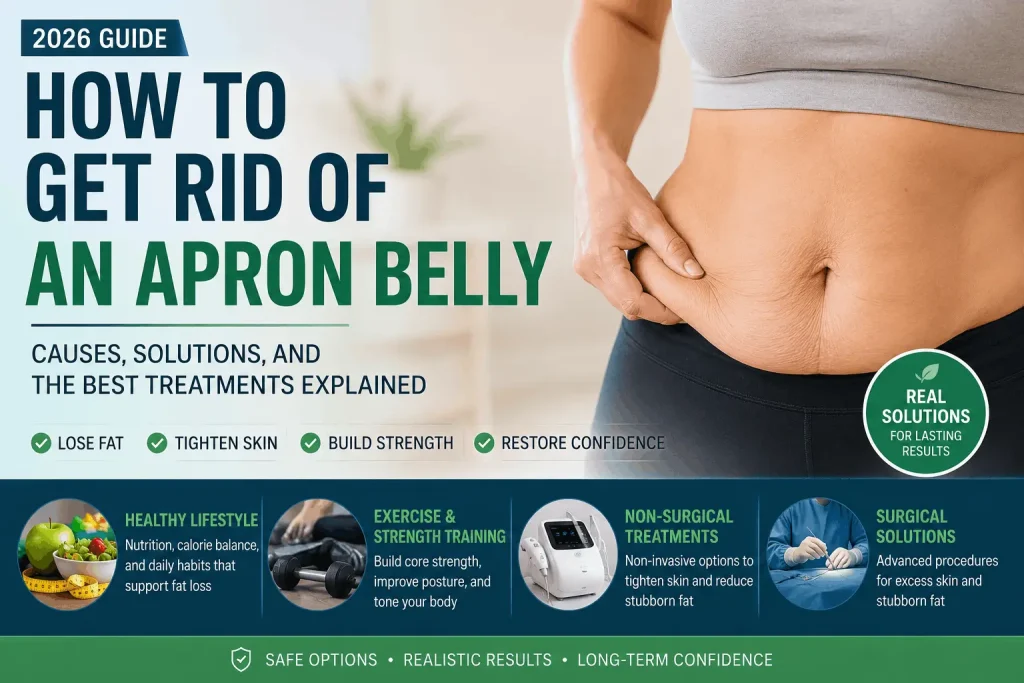
1. Can You Get Rid of an Apron Belly Naturally
Yes, an apron belly can sometimes become less noticeable naturally, but the results depend on what is causing it. If the overhang contains excess body fat, gradual weight loss through a balanced diet and regular physical activity may reduce its size over time.
However, if it is mostly made up of stretched, loose skin after pregnancy or significant weight loss, lifestyle changes alone cannot restore the skin’s elasticity or remove the excess tissue. Strengthening the core muscles can improve abdominal support and posture, making the area appear firmer, but it will not eliminate hanging skin.
For people with mild cases, healthy habits may provide meaningful improvement. When excess skin is significant or affects comfort and daily life, medical treatments or surgery are often the most effective options.
2. Lose Excess Body Fat Through Healthy Weight Loss
If excess body fat contributes to your apron belly, achieving and maintaining a healthy weight can reduce its size and improve your overall body shape.
A sustainable approach works better than rapid weight loss because losing weight too quickly may leave more loose skin behind.
Focus on a balanced eating pattern that includes lean protein, whole grains, fruits, vegetables, healthy fats, and minimally processed foods while creating a moderate calorie deficit.
Pair healthy nutrition with regular physical activity, including both strength training and cardiovascular exercise, to preserve muscle mass as you lose fat.
Keep in mind that you cannot choose where your body loses fat first, so abdominal fat may decrease gradually. If the remaining overhang is mostly loose skin, weight loss alone is unlikely to remove it completely.
3. Build Core Strength With Exercise
Building core strength can improve the appearance and function of the abdominal area, but it cannot remove an apron belly made primarily of loose skin.
Exercises that strengthen the deep abdominal muscles, lower back, and pelvic floor help improve posture, increase trunk stability, and provide better support for the abdominal wall.
For people with mild abdominal laxity or postpartum muscle separation (diastasis recti), a structured exercise program guided by a qualified healthcare or rehabilitation professional may reduce abdominal bulging and improve core function. Combining strength training with regular aerobic exercise also supports overall fat loss and long-term weight management.
However, no exercise can target fat loss in one specific area or restore permanently stretched skin. If significant skin overhang remains after reaching a healthy weight, medical or surgical treatment may be needed.
4. Improve Posture to Make an Apron Belly Less Noticeable
Improving your posture will not remove an apron belly, but it can make the abdominal area appear more balanced and reduce strain on your body.
Standing with your shoulders relaxed, spine in a neutral position, and core muscles gently engaged can improve body alignment and help the abdomen project less. Good posture also distributes body weight more evenly, which may reduce stress on the lower back and improve comfort during daily activities.
Regular exercises that strengthen the core, back, and hip muscles can make it easier to maintain proper posture over time. While these changes may improve your overall silhouette and confidence, they do not eliminate excess fat or loose skin.
If an apron belly is caused mainly by stretched skin, posture improvement should be viewed as a supportive strategy rather than a permanent treatment.
5. Wear Compression Garments for Better Support
Compression garments, such as abdominal binders, support bands, or high-compression shapewear, cannot reduce fat or remove loose skin, but they can make an apron belly feel more comfortable during daily activities.
By providing gentle support to the lower abdomen, they may reduce movement, improve clothing fit, and lessen discomfort while walking or exercising.
Some people also find that compression garments help improve posture by supporting the abdominal and lower back muscles. However, they should fit properly without being excessively tight, as overly restrictive garments can cause discomfort and may trap heat and moisture against the skin.
If you have a large skin fold, remove the garment daily, clean and thoroughly dry the area underneath, and watch for signs of irritation or infection.
6. Care for the Skin Under an Apron Belly
Proper skin care is an important part of managing an apron belly because the skin fold can trap heat, sweat, and moisture, increasing the risk of irritation and infection. Wash the area daily with a gentle cleanser, then dry it thoroughly by patting rather than rubbing the skin.
Keeping the fold dry throughout the day can help reduce friction and limit the growth of bacteria and fungi. If recommended by your healthcare provider, moisture-absorbing powders, barrier creams, or antifungal treatments may be used when irritation or recurrent infections occur. Soft absorbent liners placed within the skin fold may also reduce moisture and chafing.
If you notice persistent redness, pain, unpleasant odor, drainage, or skin breakdown, seek medical evaluation promptly, as these may indicate an infection requiring treatment.
7. Non-Surgical Treatments for Apron Belly
Radiofrequency Skin Tightening
Radiofrequency (RF) skin tightening is a non-surgical treatment that uses controlled heat to stimulate collagen production and improve skin firmness. It may be a suitable option for people with a mild apron belly caused by loose skin and small, localized fat deposits, but it cannot remove large amounts of excess skin.
During the procedure, a handheld device delivers radiofrequency energy beneath the skin to encourage tissue remodeling over the following weeks and months.
Most treatments require little or no downtime, although multiple sessions are often needed for the best results. Improvements are usually gradual rather than immediate, and outcomes vary depending on skin quality, age, and the amount of laxity present.
For moderate to severe apron belly with significant skin overhang, surgical treatment generally provides more noticeable and lasting improvement.
Ultrasound Skin Tightening
Ultrasound skin tightening is a non-invasive treatment that uses focused ultrasound energy to heat deeper layers of tissue, stimulating the body’s natural collagen production. It is most effective for people with mild to moderate skin laxity rather than a large apron belly with significant excess skin.
Because the treatment works by encouraging gradual collagen remodeling, results develop over several months as new collagen forms. Most people can return to their normal activities immediately after treatment, although mild redness or tenderness may occur temporarily. Ultrasound skin tightening does not remove loose skin or produce substantial fat reduction, so it is not a replacement for body contouring surgery.
People with severe skin overhang after major weight loss or pregnancy generally achieve more noticeable improvement with procedures such as abdominoplasty or panniculectomy, while ultrasound may help maintain results or address mild laxity.
Laser Skin Tightening
Laser skin tightening is a non-surgical procedure that uses controlled laser energy to heat the deeper layers of the skin, stimulating collagen production and improving skin firmness over time. It is best suited for people with mild to moderate skin laxity rather than a large apron belly with substantial loose skin.
Because collagen remodeling occurs gradually, improvements typically become more noticeable over several weeks to months, and multiple treatment sessions may be recommended.
Recovery is usually minimal, allowing most people to resume normal activities shortly after treatment. Although laser treatments can improve skin texture and elasticity, they cannot remove excess skin or significantly reduce a large abdominal overhang.
For individuals with severe skin laxity following pregnancy or major weight loss, surgical procedures such as abdominoplasty or panniculectomy generally provide more predictable and substantial results.
Cryolipolysis (Fat Freezing)
Cryolipolysis, commonly known as fat freezing, is a non-surgical body contouring treatment that uses controlled cooling to destroy fat cells beneath the skin.
Over the following weeks and months, the body gradually removes these damaged fat cells through natural metabolic processes, leading to a reduction in localized fat deposits.
This treatment is most suitable for people who are close to their target weight but have small areas of stubborn abdominal fat that have not responded to diet and exercise. Cryolipolysis is not a weight-loss procedure and cannot remove loose skin or treat a large apron belly caused primarily by excess skin.
While some people may notice mild skin tightening, current evidence suggests this effect is limited and inconsistent. Individuals with significant skin overhang generally achieve better results with surgical treatment.
RF Microneedling (Optional if included)
Radiofrequency (RF) microneedling combines tiny sterile needles with controlled radiofrequency energy to stimulate collagen and elastin production in the deeper layers of the skin.
It is primarily used to improve mild to moderate skin laxity, making it a potential option for people with a small apron belly caused by reduced skin firmness rather than significant excess skin.
The treatment creates controlled micro-injuries while delivering heat beneath the skin, encouraging gradual tissue remodeling over the following weeks and months. Most people require a series of treatment sessions to achieve the best results, and mild redness or swelling usually resolves within a few days.
Although RF microneedling can improve skin texture and firmness, it cannot remove large amounts of loose skin or replace procedures such as abdominoplasty or panniculectomy when skin overhang is severe.
8. Liposuction for Stubborn Belly Fat
Liposuction is a surgical body contouring procedure that removes localized fat deposits that have not improved with diet and exercise.
It is most appropriate for people who are close to a stable, healthy weight but have stubborn abdominal fat with good skin elasticity. During the procedure, a surgeon removes fat through small incisions using a thin tube called a cannula, creating a more defined abdominal contour.
However, liposuction does not tighten stretched abdominal muscles or remove excess loose skin, so it is usually not the best standalone treatment for a true apron belly.
If significant skin overhang is present after pregnancy or major weight loss, liposuction is often combined with procedures such as abdominoplasty to achieve better contour and more balanced, longer-lasting results.
Keeping the fold dry throughout the day can help reduce friction and limit the growth of bacteria and fungi. If recommended by your healthcare provider, moisture-absorbing powders, barrier creams, or antifungal treatments may be used when irritation or recurrent infections occur. Soft absorbent liners placed within the skin fold may also reduce moisture and chafing.
If you notice persistent redness, pain, unpleasant odor, drainage, or skin breakdown, seek medical evaluation promptly, as these may indicate an infection requiring treatment.
9. Tummy Tuck (Abdominoplasty)
A tummy tuck, also called an abdominoplasty, is the most effective surgical treatment for an apron belly caused by excess skin, stubborn fat, and weakened abdominal muscles.
During the procedure, a plastic surgeon removes loose skin and excess fat while tightening separated or stretched abdominal muscles, which commonly occur after pregnancy or significant weight loss. This creates a flatter, firmer abdominal contour and may improve core support.
A tummy tuck is a body contouring procedure, not a weight-loss surgery, so it is generally recommended for people who are close to their goal weight and can maintain it long term. Recovery typically involves several weeks of restricted activity, with final results becoming more apparent as swelling gradually resolves over several months.
As with any surgery, discussing benefits, risks, and recovery expectations with a board-certified plastic surgeon is essential before proceeding.
10. Panniculectomy
A panniculectomy is a surgical procedure that removes the excess skin and fat forming an apron belly, particularly when the overhang causes physical problems such as recurrent skin infections, rashes, difficulty with hygiene, or restricted movement.
Unlike a tummy tuck, a panniculectomy focuses on removing the hanging tissue and does not tighten or repair the abdominal muscles.
For this reason, it is considered a functional procedure rather than a cosmetic body-contouring surgery, although many people also notice a significant improvement in their abdominal shape. The procedure is often recommended after major weight loss when weight has stabilized and excess skin remains.
Recovery usually requires several weeks of limited activity, and complete healing takes time. In medically necessary cases, health insurance may cover part or all of the procedure, depending on the policy and eligibility criteria.
11. Combined Procedures (Tummy Tuck + Liposuction / Hybrid Approach)
Many people with an apron belly have a combination of excess fat, loose skin, and weakened abdominal muscles, making a combined approach more effective than a single procedure.
A tummy tuck with liposuction allows the surgeon to remove stubborn fat, excise excess skin, and repair separated abdominal muscles during the same operation, creating a more balanced abdominal contour than either procedure alone.
In selected patients, additional minimally invasive skin-tightening technologies may also be used to enhance contouring, although they do not replace surgery when significant skin overhang is present. The most appropriate combination depends on factors such as skin quality, fat distribution, muscle separation, overall health, and personal goals.
A consultation with a board-certified plastic surgeon is essential to determine the safest treatment plan and set realistic expectations for recovery and long-term results.
12. Which Apron Belly Treatment Is Right for You
The best treatment for an apron belly depends on what is causing the abdominal overhang.
If excess body fat is the primary concern, healthy weight loss, regular exercise, and, in some cases, body contouring procedures may improve the appearance.
When mild skin laxity remains after weight loss or pregnancy, non-surgical skin-tightening treatments may provide modest improvement, although results are generally limited.
If the overhang consists mainly of excess skin or is accompanied by separated abdominal muscles, procedures such as a tummy tuck or panniculectomy usually provide the most effective and lasting results. Your overall health, body weight, skin quality, future pregnancy plans, and personal goals should all be considered before choosing treatment.
A consultation with a board-certified plastic surgeon can help determine which option is most appropriate for your individual needs and expectations.

Conclusion
Getting rid of an apron belly starts with understanding what is causing it.
Healthy weight loss, regular exercise, and proper skin care can improve mild cases and support long-term health, while non-surgical treatments may offer modest improvements for selected individuals. When excess loose skin or weakened abdominal muscles are the main concern, procedures such as a tummy tuck or panniculectomy generally provide the most effective results.
The best treatment varies from person to person, so an evaluation by a qualified healthcare provider or board-certified plastic surgeon is essential. With realistic expectations and the right treatment plan, many people can improve both comfort and confidence.